Search marketing has collected two more acronyms. SEO vs AEO vs GEO is often illustrated in a tidy Venn diagram with overlapping circles and some very confident percentages. The circles are useful but the percentages need more scrutiny.
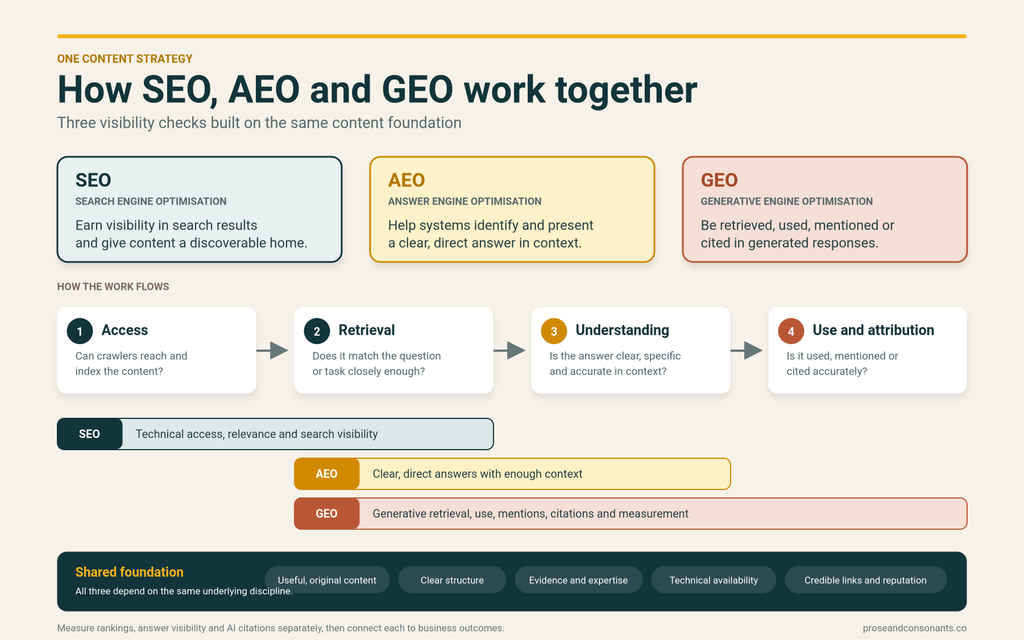
At a practical level, the three terms describe different ways your content can be discovered and used. SEO helps a page earn visibility in search results. AEO helps a search engine or assistant give a clear, direct answer. GEO focuses on whether a generative system retrieves, uses, mentions or cites your content in a generated response.
They share most of their foundations. A page still needs to be accessible, relevant, useful and trustworthy. It also needs something worth retrieving in the first place. Most businesses can run one sound content strategy and check it through three visibility lenses.
SEO vs AEO vs GEO: The short version
| SEO | AEO | GEO | |
| Full name | Search engine optimisation | Answer engine optimisation | Generative engine optimisation |
| Main aim | Help the right page be found, ranked and chosen in search | Help an engine give an accurate, useful answer | Improve the chance of being retrieved, represented, mentioned or cited in a generated answer |
| Common surfaces | Organic results, images, video, local and product results | Featured snippets, People Also Ask, voice and other direct-answer experiences | Google AI Overviews and AI Mode, ChatGPT search, Microsoft Copilot, Perplexity and similar tools |
| Typical measures | Impressions, clicks, rankings, organic conversions and indexation | Answer-feature visibility, answer accuracy and assisted actions | Citations, mentions, share of voice, referred visits, brand accuracy and conversions |
| Main question | Can people and search engines find and choose this page? | Can the answer be understood and presented clearly? | Is this source retrieved and used accurately in generated responses? |
Those definitions are working definitions, because the industry has not settled on one clean vocabulary. Some platforms use AEO as the umbrella term for all AI search work. Others reserve AEO for direct answers and GEO for generative systems. Google treats both as labels for work that still sits within SEO on Google Search.
That lack of agreement explains why two perfectly polished diagrams can give you different answers.
What SEO covers
SEO helps search engines discover, understand and serve your content, then helps people decide whether to visit it. That is close to Google’s own definition.
It includes more than keywords and backlinks. A useful SEO programme covers:
- Technical access, including crawling, indexation, canonical URLs, mobile usability and page performance
- Relevance and search appearance, including intent, titles, headings, internal links, descriptions and media
- Content quality, including accuracy, depth, originality and a satisfying reader experience
- Authority and trust, including earned links, credible references, clear authorship and a consistent reputation
SEO is still the foundation for much of AI search. Google says its generative search features use its search index and core ranking and quality systems to retrieve current pages. The systems may also fan out one complex question into several related searches before building an answer.
That matters because a page cannot become a useful source if the system cannot access or retrieve it. Strong technical SEO and clear topical relevance give AEO and GEO something to work with.
What AEO adds
Answer engine optimisation focuses on the answer itself. It asks whether a machine can identify the relevant passage, understand it in context and present it without losing an important qualification.
AEO was associated with featured snippets, People Also Ask and voice assistants before generative AI arrived. Some marketers now use it for every answer-led interface, so define the term when you use it. Good AEO tends to look like good explanatory writing:
- Make the question or topic clear and give the reader a useful answer early
- Keep definitions, steps, comparisons and conditions easy to follow
- Name the people, products and concepts you mean, then support factual claims with suitable evidence
- Keep limits and exceptions close to the claim so an extracted answer stays accurate
Featured snippets are selected by Google’s systems. Publishers can make content eligible and can control whether snippets are allowed, but there is no switch that awards the answer box.
FAQ sections can still help readers when the questions are genuine. FAQ schema is a different matter. Google stopped showing FAQ rich results in May 2026 and removed the supporting documentation the following month. Adding FAQ markup across every article is therefore not an AEO shortcut. Structured data remains useful when it accurately describes the page and supports a search feature that still exists.
What GEO adds
Generative engine optimisation focuses on generated responses. These systems may search for sources, retrieve passages, combine information from several places and write a new answer with links or citations.
The term was formalised in research first released in 2023 and accepted at KDD 2024. The study found visibility gains of up to 40 per cent for some methods and domains, including relevant quotations, citations and statistics.
That finding is interesting. It is not a promise that a few statistics will give your website a 40 per cent better chance of appearing in ChatGPT.
In the main experiment, the source was already among a fixed set of retrieved documents. The study measured its prominence in the generated answer, not a universal probability of organic discovery, citation or traffic. A 2026 critical review found that evidence is strongest after retrieval, while stable effects on cross-platform discovery and business outcomes remain unproven.
That gives us a sensible way to use GEO today. Treat it as a disciplined, measurable extension of search and content work. Avoid treating it as a bag of guaranteed hacks.
Where SEO AEO and GEO meet
A layered model is more useful than three competing strategies.
First comes access. Crawlers need permission to reach indexable content. OpenAI says sites should allow OAI-SearchBot for eligibility in ChatGPT search. GPTBot has a separate purpose, so a site can allow search visibility while opting out of model-training crawls.
Then comes retrieval. The page needs to match a real question or task. Topic coverage, internal links, external references and source reputation can help an engine decide that it belongs in the candidate set.
Then comes understanding. Clear headings, descriptive language, useful tables and supported claims help people scan and systems identify the relevant information.
Then comes use and attribution. A system may cite the page, mention the brand, paraphrase an idea without a link or ignore it after retrieval. GEO measures those outcomes and any referral or conversion that follows.
The common centre is useful, original, trustworthy content. Google emphasises non-commodity content with first-hand experience and a distinct point of view. Microsoft advises publishers to improve depth, structure, evidence and consistency across formats.
In other words, clarity helps. Evidence helps. Distinct expertise helps most when it gives the page a genuine reason to be selected.
What the diagrams get right and what needs an edit
The images capture an important truth. Technical health, authority, useful content and clear organisation support rankings, direct answers and AI citations. A few parts need updating.
AEO is wider than generative AI
The first diagram puts generative AI visibility inside AEO. That reflects one current use, although AEO has also covered non-generative answer surfaces for years. Define the term when you use it.
GEO is not simply the perfect middle
GEO has its own retrieval, generation, citation and measurement questions. It depends on SEO foundations and benefits from AEO clarity. “Maximum brand visibility” describes an ambition, not a capability.
Citation percentages need a source and a method
The three percentage ranges in the first image should not be used as benchmarks. They give no engine, query set, geography, time period, sample size or method. The original “up to 40 per cent” GEO result measured relative visibility in a specific experiment. It did not produce those citation probabilities.
FAQ schema is no longer a general Google opportunity
The second diagram reflects older guidance. Google no longer shows FAQ rich results. FAQs can still serve readers and accurate structured data can support eligible features. Neither guarantees a citation.
Freshness means meaningful maintenance
Update content when the facts, product, market or reader need changes. Google warns against changing a date when the content has not substantially changed.
A practical workflow that supports all three
Start with a real buyer question
Use customer conversations, site search and search data to find a question connected to a genuine decision. Define what the reader knows and what they should be able to do after reading. Use related searches to map meaningful subquestions, without creating a thin page for every prompt variation.
Gather evidence before drafting
Collect primary sources, current product documents, original data, expert interviews and examples. Record the source, date, scope and qualification for important claims.
Answer clearly and then earn the reader’s time
Give a concise answer near the start of the relevant section, then add the mechanism, context, limits, examples and next step. Use descriptive headings and ordinary language. Keep qualifications close to the claim they limit.
Make the source easy to assess
Show who wrote or reviewed the content and why they know the subject. Cite checkable evidence. Keep company, product and service descriptions consistent across your site and credible third-party profiles.
Complete the technical basics
Check the page status, indexability, sitemap, internal links, canonical tag, mobile experience, speed and rendered content. Review OAI-SearchBot access for ChatGPT search. Use Bing Webmaster Tools and consider IndexNow when timely updates matter.
Use structured data that truthfully matches the visible page and a supported use case. Google says there is no special schema required for generative search and warns against overfocusing on it.
Build real corroboration
Create something worth referring to, such as original research, a practical framework, a case study or a clear expert explanation. Credible links and mentions support authority and help your brand appear consistently beyond its own site.
The tools worth using
Start with first-party data. Add third-party tracking when it answers a decision those reports cannot.
| Job | Useful tools | What to look for |
| Search demand and performance | Google Search Console, Bing Webmaster Tools, Semrush or Ahrefs | Queries, impressions, clicks, landing pages, topic gaps and search features |
| Crawl and indexation | Search Console URL Inspection, Bing Webmaster Tools, Screaming Frog or Sitebulb | Blocking, status codes, canonicals, internal links, sitemaps and duplicates |
| Page experience | PageSpeed Insights and Lighthouse | Real-user and lab performance, mobile issues and diagnostics |
| Structured data | Rich Results Test and Schema.org Validator | Valid, accurate markup and supported-result eligibility |
| Google AI visibility | Search Console Generative AI performance report | AI Overview and AI Mode impressions by page, country, device and date |
| Microsoft AI visibility | Bing Webmaster Tools AI Performance | Citations, cited pages, grounding-query samples and trends across supported Microsoft experiences |
| Cross-platform AI monitoring | Semrush, Brand Radar, Profound, Peec AI, Scrunch AI or OtterlyAI | Mentions, citations, competitors, sources and priority prompts |
| Business outcomes | Your analytics and CRM | AI referrals, engaged visits, enquiries, assisted conversions and revenue |
Cross-platform reports remain samples shaped by each provider’s prompts, models, locations, settings and dates. No third-party tool has access to an engine’s internal ranking systems. Use these tools as monitoring instruments, not as an oracle.
How to measure progress without fooling yourself
Use a scorecard with separate lines for discovery, answer visibility and business value.
For SEO, track relevant impressions, clicks, indexation, non-branded query coverage and conversions. Rankings can help diagnose movement, although one average position rarely tells the whole story.
For AEO, track whether priority questions trigger answer features, whether your content is used and whether the extracted answer stays accurate. Record the date, country and device for manual checks.
For GEO, track citations and mentions across a fixed prompt set, then add cited pages, referrals, conversions and brand accuracy. Google now reports AI Overview and AI Mode impressions. Bing reports citation activity and grounding-query samples across supported Microsoft experiences.
Run important prompts more than once and keep each engine separate. Generated answers can change with wording, location, time, personalisation and the system’s own variability. One screenshot is an observation. A repeated, dated panel is a measurement.
Connect visibility to a business outcome. A citation that brings no relevant attention may build familiarity, although it should not automatically be valued like an enquiry or sale.
One strategy with three visibility checks
One strong strategy can cover the shared work. Choose topics that matter to a defined audience and your business. Create original, expert-led material, publish it on a crawlable site and structure it clearly. Earn credible exposure beyond your own domain, then measure search visibility, answer visibility and outcomes separately.
SEO gives the work reach and a discoverable home. AEO sharpens the answer. GEO asks whether generative systems can find, use and attribute that work. The three concepts support one another because they reward the same underlying discipline: publish something genuinely useful, make its meaning clear, show why it should be trusted and keep it technically available.
The acronyms will keep moving. That foundation is far more durable.
Need help with content strategy, writing, or editing?
I help B2B, technology, cybersecurity, privacy, and legal teams plan, write, and improve content.
Email me